

Agentic Awareness: Why Crypto Sits at the Core of a Machine-Native Economy
As AI agents reshape the economy, crypto emerges as the infrastructure layer they require — and a potential beneficiary of that shift.


"AI will be able to do everything. We need to grapple with that.”
— Dario Amodei, Co-Founder & CEO Anthropic
Across AI labs, founders, and engineers working at the frontier, there is a growing sense of alignment:
What is being built will not just improve existing systems. It will fundamentally reshape them.
And it may happen faster than most expect.
Dario Amodei, the founder of Anthropic, recently said that some aspects of AI progress make him optimistic. Others concern him. What concerns him most is how unprepared we, as a society, are for what it implies.
He described it like this:
People are standing on a coastline. Out in the distance, a massive wave is forming. They can see it clearly. It is building, visibly, in front of them. And people are watching it. Some point at it. Some discuss whether it is real. Some argue it might dissipate before it reaches the shore.
But most remain where they are.
They don’t move. They don’t prepare.
And that, more than the wave itself, is what concerns him. Because by the time its impact becomes undeniable, it may already be too late to react.
To stay within Amodei’s analogy: if this wave continues on its current trajectory, it will eventually reach shore. The question is: What happens when it does?

When the Wave Hits Land
A report by Citrini Research, “The 2028 Global Intelligence Crisis”, attempts to map that moment and it does something unusual.
Instead of discussing AI in abstract terms, it places the reader into a near future — June 2028 — and describes what the world might look like after the widespread deployment of AI agents. Not as a prediction, but as a scenario.
The value of the report lies not in whether every detail will unfold exactly as described. It lies in the logic of the sequence. The chain of events feels internally consistent. And once you follow that logic step by step, it becomes difficult to dismiss.
It begins, as many technological shifts do, with efficiency.
Companies start integrating increasingly capable AI systems into their operations. At first, the effects are almost entirely positive. Tasks that previously required entire teams can now be executed faster, cheaper, and with fewer people. Workflows become more efficient.
From a financial perspective, it looks like a clear win. Costs decline. Margins expand. Earnings improve. Investors reward this efficiency. Stock prices rise.
This is not just theoretical.
On February 26th 2026, the payment company Block Inc. (formerly Square) announced AI-driven layoffs affecting roughly 4,000 employees — around 50% of its workforce. The market reaction was immediate: the share price rose by 28% in a single day.
But beneath that surface, something more structural begins to shift. Not abruptly, but gradually, and then all at once. Work that was once considered relatively stable, particularly in white-collar professions, starts to fragment. A function that once required ten people might now require five. Then three. Then one. In some cases, none.
At first, these changes are absorbed. Teams are reorganized. Hiring slows. Roles evolve. But over time, the pattern becomes harder to ignore. Entire categories of work begin to compress.
At the same time, the very force driving this efficiency also lowers barriers across the system.
If AI reduces the cost of building products, then more people — and increasingly, more systems — can build them. What once required significant capital, time, and coordination can now be assembled with far fewer resources. Competition increases. Products that once took years to build can now be assembled in weeks — in some cases, even faster.
In February 2026, a CNBC journalist built a functional clone of monday.com, a widely used project management platform, in roughly an hour using Anthropic’s Claude, at a cost of around $15. What would previously have required a full engineering team, months of development, and significant capital was reduced to a single prompt-driven workflow. The software company’s share price is since down 82%.
Examples like this illustrate the direction of travel.
As barriers compress, competition does not just increase, it accelerates.
Margins begin to come under pressure again. And this is where the dynamic becomes reflexive.
Less income → less demand → more pressure on margins → more automation → less income.
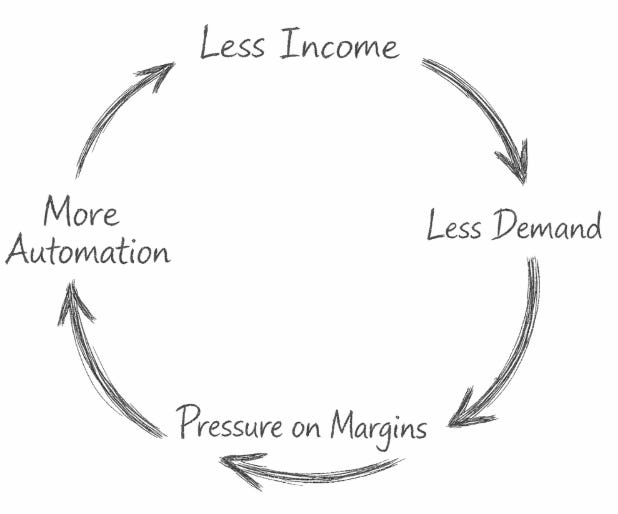
What begins as a productivity story slowly turns into something broader. A shift in how economic value is created. A shift in who participates in that process. And ultimately, a shift in how stable the system feels.
Again, this is only one possible path.
No one knows exactly how this will play out. Not even the people building these systems. The future — especially in moments like this — is messy. Non-linear. Full of second-order effects that are difficult to predict. We know we cannot predict it with precision. But as investors, we need to prepare for it with clarity. And that starts with stepping back.
In environments like this — where the surface is noisy and the outcomes uncertain — it helps to return to first principles. To strip away assumptions. To ignore narratives. And to focus on what appears structurally true.
This does not guarantee that we will be right. But it provides a framework to think clearly when everything else becomes harder to interpret.
There are a few observations that for us, at this point, seem difficult to argue against.
1. AI systems are getting better.
Over the past two years, we have witnessed a clear step-change in AI capability. Tasks that previously required continuous human intervention can now be executed autonomously. AI systems are increasingly able to reason, plan, and operate across multiple steps without supervision.
A useful way to frame this progress is through what METR (Model Evaluation & Threat Research) defines as the AI Task Completion Time Horizon — the length of a task, measured in human working time, that an AI system can complete independently with a given success rate.
From this perspective, recent advances are striking. What only a few years ago was limited to tasks taking seconds has expanded to minutes, and more recently to hours. Frontier systems are now approaching the ability to handle tasks that would take humans several hours to complete in a single uninterrupted stretch.
Crucially, this progress is not linear. Empirical observations suggest that the time horizon has been doubling roughly every 6–8 months. This exponential trend helps explain why the shift feels sudden: capabilities compound, rather than simply improve incrementally.
2. As AI capability increases, uncertainty in the markets increases.
As AI systems become more capable, something more subtle begins to happen.
It becomes harder to understand what is actually durable. Not because the technology is unreliable, but because its consequences are difficult to fully map.
For decades, investors operated under a relatively stable set of assumptions. That certain capabilities were scarce. That expertise took time to build. That human labor was the foundation of economic output. And economic growth lead to more employment. Growth required labor.
AI begins to challenge those assumptions.
What happens when agentic labor outperforms human labor — not in some tasks, but across most economically relevant ones?
What does that do to businesses built around human expertise?
What does that do to cost structures, to competition, to margins?
And more broadly: what does that do to income, to demand, and to the stability of the system itself?
These are not abstract questions. They go to the core of how value is created — and who captures it.
And they do not have clear answers.
That is precisely the point.
As the range of possible outcomes expands, confidence in any single outcome declines. And as confidence declines, uncertainty begins to increase.
3. Financial markets price the future.
At its core, investing is a question of duration. As an equity investor, you are not just buying earnings. You are buying the expectation that those earnings will persist over time. For years, markets operated under the assumption that certain businesses had long, defensible lifecycles. Scale protected them. Distribution protected them. Switching costs protected them. Time was embedded in the price.
But when uncertainty increases, those assumptions begin to weaken.
And when the durability of cash flows becomes harder to assess, valuation frameworks start to adjust. What once looked like a ten-year advantage may start to look like a three-year window. What once justified a premium multiple may no longer do so.
When that happens, the effects are broad. This is not about a single sector. It cuts across the system. Multiples compress. Volatility increases. Confidence declines.
And when confidence declines, capital does not stay where it is. It moves. Some of it moves into assets perceived as stable. But some of it looks for something else. Alignment — with the force that is driving the change in the first place.
And that shifts the question. From what is being disrupted — to what is being built.
From Human Economy to Agent Economy
To understand where the world might be heading, it helps to zoom out.
The global economy, as it exists today, is fundamentally human-centric. It is built around human labor, human income, and human consumption.
Entire industries exist to serve human needs. Food. Housing. Transportation. Entertainment. Status. Experience.
If you were to map it, it would resemble something like Maslow’s hierarchy of needs expressed at scale. The economy, in many ways, is a reflection of what humans require to survive, function, and aspire.
But what happens when humans are no longer the only economic actors?
What Do AI Agents Need?
As AI systems become more capable, they do not just assist humans — they begin to take on more of the work itself.
Today, much of what is described as “AI” in practice still operates within human-defined workflows. A system might summarize information, generate content, or execute a sequence of predefined steps — often triggered, supervised, or validated by a human. These systems can be highly effective. But they are not autonomous. They extend human capability rather than replace it.
But this is beginning to change.
As models improve, systems are no longer limited to executing isolated tasks. They can plan, reason across multiple steps, use tools, and adapt their behavior based on outcomes — operating with a meaningful degree of autonomy.
This is where the concept of AI agents becomes relevant.
AI agents are software systems that can autonomously plan and execute tasks in pursuit of a goal. They break problems into steps, interact with tools and services, coordinate with other systems, and adapt their behavior without continuous human supervision. In that sense, they are not just tools — they are actors.
And importantly, they will not exist in isolation.
If each human is supported by multiple agents — Jensen Huang, Co-Founder and CEO of Nvidia, recently stated that he is expecting a ratio of 1 human to 100 agents — we are talking about potentially tens or hundreds of billions of autonomous actors operating in parallel.
At that scale, this is no longer just software interacting with software. Agents will transact, negotiate, and coordinate with one another. What emerges is a continuous layer of economic activity between machines.
An agent-to-agent (A2A) economy.
And this economy operates under very different constraints. Understanding those constraints is not theoretical. It is how you begin to understand where value will be created — both within and through this new system.
And for investors, that is where the focus needs to be. Because if you understand what these systems cannot function without, you begin to see where value is most likely to accrue.
So to understand what this new economy might look like, we need to start with a fundamental question:
What do agents actually need?
Put differently: what will they consume, and what will they pay for?
The Agent Economy
The human economy is built around human needs. The agent economy will not be. Agents do not need food, shelter, or status. They do not consume experiences. Which means demand, in this new economy, will look fundamentally different. It will not be driven by lifestyle. It will be driven by function.
The relevant question, therefore, is what agents require in order to operate. To perform work. To make decisions. To interact with other systems.
And once you frame it that way, the structure of this new economy starts to become clearer.
At the most fundamental level, agents need energy. Not in the human sense. Not calories or food.
But they do require a digital equivalent: compute.
Without compute, an agent cannot reason, plan, or act. In short, it cannot function as an economic participant at all. If food is the basic input of the human economy, then compute is the basic input of an agent-driven economy.
Closely tied to this is data.
For humans, perception is shaped by the physical world. We see. We hear. We experience. That is the basis on which we make decisions. Agents do not have that interface. They perceive the world only through data. Everything an agent “knows” about its environment — prices, markets, users, systems, conditions — is encoded in data. Data is not just an input. It is the agent’s entire window into reality. Which means that access to relevant, timely, and reliable data is not optional. It is foundational.
But compute and data alone are not enough.
An agent may be intelligent. It may be well-informed. It may have access to immense processing power. And still, it cannot truly participate in an economy unless it can do more than think.
It must be able to move through digital environments, identify itself, enter into agreements, evaluate counterparties, own assets, and pay.
Once you look at these requirements more closely, something becomes apparent.
The human economy is full of friction because it was built for humans.
We rely on institutions, intermediaries, legal interpretation, office hours, borders, contracts written in different languages, and high-friction payment systems with slow settlement. None of these systems are perfectly efficient. But they work.
Agents operate on clear inputs and predictable outcomes. In environments where results are uncertain, delayed, or dependent on interpretation, their ability to function breaks down. Which creates a fundamental mismatch. Because the systems that underpin today’s economy were not designed for machine-native activity.
So the question becomes: What kind of system is required for agents to operate reliably as economic actors — at scale?
To answer that, we need to be more precise.
How do they enter into agreements — in a way that can be executed without ambiguity?
How do they pay for services — instantly, and without relying on human workflows?
How do they identify themselves and assess counterparties?
And how do they access capital, allocate resources, and interact with markets?
These are the minimum requirements for participation in any economic system. To understand what kind of infrastructure can support an agent-driven economy, we will look at each of these in more detail.
1. (Smart) Contracts & Settlement — Agents require agreements that execute and settle automatically
Traditional legal contracts are inherently interpretive. They are written in natural language, leaving room for negotiation, judgment, and ambiguity. Their enforcement depends on lawyers, jurisdictions, and often slow court procedures — and even then, outcomes can remain uncertain.
This works in a human context, where ambiguity can be managed, negotiated, and absorbed.
Agents require deterministic rules — systems where the same inputs reliably produce the same outputs. In other words, execution must be predictable, verifiable, and free from interpretation. This stands in contrast to the probabilistic nature of human systems, where outcomes often depend on context, judgment, and discretion.
This is where smart contracts become relevant.
A smart contract is a piece of code deployed on crypto networks that automatically execute predefined rules when certain conditions are met. Unlike traditional agreements, they do not rely on interpretation or enforcement after the fact. Execution and settlement are built into the system itself. Once triggered, they execute exactly as written — and once executed, they cannot be reversed. They can be read, executed, and settled at the speed of block finality — on many modern networks, already well below one second.
And it is precisely this requirement that makes crypto networks the natural execution layer for agents. Because they provide something traditional systems cannot: rules that are not just agreed upon, but enforced automatically, globally, and without ambiguity.
2. Payments — Agents need to pay instantly, programmatically, and globally
Do you believe AI agents will open an account at the local bank? Or that they will pause on weekends because bank office hours say so?
Likely not. These systems were not built for machine-native activity.
That is the limitation.
Traditional payment systems are built around human workflows: settlement is slow and can take days, access is restricted by geography, and many processes are unavailable on weekends and after office hours. Every interaction depends on layers of intermediaries — banks, card networks, payment processors — each introducing cost, latency, and friction.
Agents cannot rely on manual approvals. And they cannot efficiently navigate fragmented systems with delayed finality. At scale, these constraints are not just inconvenient. They are limiting.
What agents require instead are payment rails that are always on. Programmatic (meaning transactions can be initiated, executed, and settled directly by software without human intervention). Globally accessible. Capable of settling transactions instantly.
This is exactly how crypto networks are designed to operate.
Transactions can occur 24/7. Globally. Without permission. Without interruption. They can be settled instantly and in any size — from large transfers down to microtransactions measured in fractions of a cent.
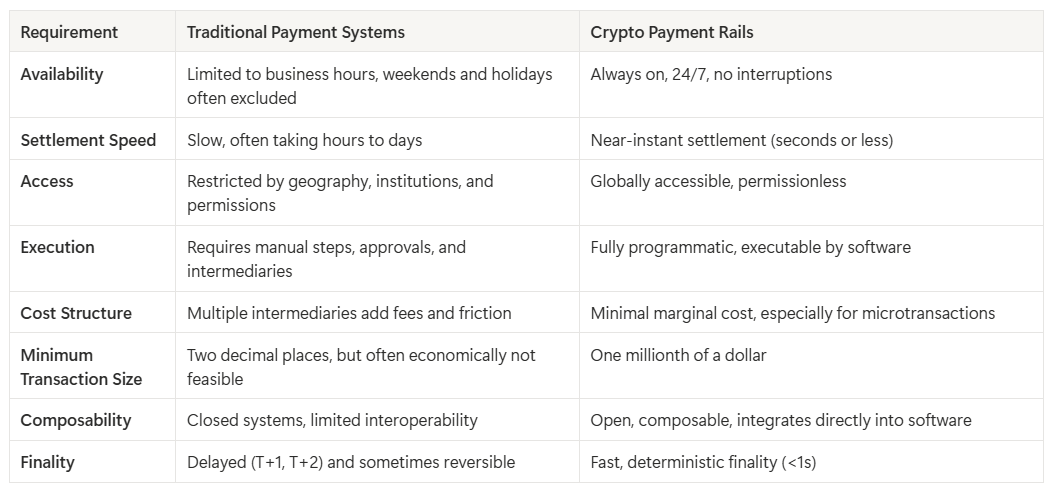
Agents will pay on crypto rails using stablecoins or other digital assets, because these networks offer capabilities that traditional payment systems simply cannot match.
And crypto rails will not just improve existing payment flows. They enable entirely new ones.
Instead of monthly subscriptions, services can be priced in real time. Agents can pay per API call. Per unit of compute. Per dataset accessed. Value begins to move continuously — not in fixed billing cycles, but as a continious stream. Today we stream music, soon we will stream money.
Interestingly, the idea is not new. In the early days of the internet, engineers defined HTTP status code 402, “Payment Required,” as a placeholder for future internet-native payments. It was a remarkably visionary move: the architects of the internet anticipated that payments would eventually become a native layer of the web, even if the technology to support it did not yet exist. The concept would allow websites to require a small payment before granting access to content or services. For more than 30 years, the standard remained unused because the internet-native payment layer had never materialized. Instead, a complex layer of intermediaries emerged: Visa, Mastercard, PayPal, and countless payment processors, each adding friction, cost, and latency to every transaction.
Crypto is now that missing piece. The 30-year-old standard has recently been revived as x402, allowing websites and services to request small crypto payments directly from browsers or AI agents. In such a system, agents could automatically pay for digital services as they perform tasks. No intermediaries, no friction, no human in the loop.
A common counterargument is that agents could simply use existing payment methods, such as credit cards.
This is true, but only within closed ecosystems.
An agent operating inside Amazon can rely on existing payment rails. But that comes with constraints: access and economic interactions are all defined by the platform.
Open blockchain networks are not bounded in this way. They allow agents to transact globally, autonomously, and without permission, under a single unified system. That is why we believe a large share of the emerging agent economy will not run on traditional payment infrastructure, but on open crypto networks.
3. Identity & Reputation — Agents require verifiable identity and portable trust
As agents begin to interact with each other autonomously, a fundamental question emerges:
How does an agent know who — or what — it is dealing with?
Identity, in this context, cannot be vague. It cannot depend on platform-specific logins or fragmented systems. It needs to be globally verifiable. Portable. Resistant to manipulation.
Something closer to a machine-readable passport.
Crypto infrastructure enables exactly this. An agent can be assigned a unique cryptographic identity in the form of an NFT that can be verified instantly — anywhere in the world.
But identity alone is not enough.
In an agent economy, interaction is constant. Agents do not operate in isolation. They continuously select counterparties, access services, and engage in transactions.
Which raises a practical question:
Who can an agent safely interact with?
Not every agent will behave reliably. Some may fail. Some may act maliciously. And unlike humans, agents operate at scale and at speed — which amplifies the consequences of poor decisions.
This is why agents need to be able to assess behavior. Reliability. Trustworthiness.
Has this other agent followed rules and protocols? Has it behaved maliciously? What outcomes has it produced over time? In other words, identity answers who an agent is. But reputation answers how it behaves. This distinction is critical.
Today, humans rely on platform-based systems to solve this problem. Airbnb, Booking.com, and similar platforms use reviews and ratings to signal trustworthiness.
But these systems are fragmented. Reputation is locked within individual platforms. It cannot be transferred. It cannot be verified globally. For an agent economy, that is not sufficient. Reputation needs to be portable. Verifiable. And accessible across systems.
This is where crypto infrastructure introduces a fundamentally different design. By linking identity and reputation directly on-chain, agents can build a verifiable history of behavior that is not controlled by any single platform.
Think of it as a fingerprint for behavior: every action recorded, permanent, and verifiable by anyone.
Standards like Ethereum’s proposed ERC-8004 — often referred to as “Trustless Agents” — are early steps in that direction.
Together, identity and reputation form the trust layer of an agent economy. Not based on belief. But on verifiability. And because this layer must be global, interoperable, and independent of intermediaries, we believe it is far more likely to emerge on open crypto infrastructure than within closed systems.
4. Market Access — Agents require permissionless access to financial services
If agents are to act as economic participants, they will not only transact. They will also allocate. They will decide where to deploy capital. Which assets to hold. Where to seek liquidity. Where to optimize returns. In other words, they require access to markets.
So, do you believe that fully autonomous agents that manage their own funds - or act on behalf of humans - will open a traditional brokerage account on Trade Republic?
Probably not. The constraints of today’s financial system do not disappear at the market level. They carry through. The mismatch becomes clear when you look at how agents operate.
Agents do not operate in sessions. They do not wait for market hours. They do not rebalance portfolios once a quarter. They operate continuously. They evaluate opportunities across markets. They compare yields. They monitor risk. They adjust positions as conditions change — in real time.
For humans, capital allocation is periodic. For agents, it becomes continuous. That difference is structural. And it requires a different type of system.
This is where Decentralized Finance (DeFi) becomes relevant.
DeFi protocols allow agents to access financial services — lending, trading, liquidity provision — directly, 24/7, without accounts, approvals, or human intervention. And more importantly, these interactions can be executed programmatically.
From Usability to Utility: How Agents Unlock Crypto Demand
If you step back, a pattern becomes clear.
Every requirement of an agent economy — payments, settlement, identity, reputation, market access — maps directly onto primitives that crypto networks provide.
But there is a more subtle layer to this alignment.
Crypto’s biggest adoption barrier has always been usability.
Anyone who has signed transactions on chain or interacted with DeFi quickly realizes that these systems are not yet ready for the average user. They are powerful, but complex. Even experienced users make mistakes. Interpreting and executing software code is simply not natural to most people.
Agents do not have that problem. Software is their native environment. Code is their language.
They can read smart contracts, interpret complex instructions, execute precisely, and monitor systems continuously. What feels complex to humans is trivial to them.
In that sense, agents may become the missing usability layer that crypto has always lacked. Instead of interacting directly with crypto networks, humans may simply express intent — and agents will execute the necessary transactions on their behalf.
In doing so, agents will not only interact with other agents, but increasingly with existing applications, services, and businesses.
Today, there are roughly six billion internet users worldwide. The number of AI agents will likely be a multiple of that — potentially tens of billions of autonomous actors operating directly on-chain. Each of these agents interacts with crypto networks in order to perform economic activity. Every transaction, every smart contract execution, every interaction with financial services requires the use of the underlying network — and the payment of fees in its native asset. As activity increases, demand for the underlying assets becomes increasingly driven by utility.
A useful way to think about this is through the lens of a traditional economy. As economic activity grows, so does the demand for the resources required to power it. In a digital, decentralized economy, crypto assets play a similar role: they are the base layer required for the system to function.
The larger this economy becomes, the more these assets are used. Once you view it this way, the relationship between AI and crypto becomes apparent.
Crypto is not just a technology exposed to this shift. It is the infrastructure layer that enables it. And as this new economic layer expands, so does the role — and relevance — of the crypto assets that underpin it.
Who Is Human?
Up to this point, the focus has been on agents — how they operate, what they require, and the infrastructure that enables them. But this transition is not only about new participants entering the system. It also reshapes the role of the ones already in it.
Humans.
As agents become more capable and increasingly present across digital environments, a new kind of problem begins to emerge. A problem that is very fundamental in nature.
How do we know what is human?
Closed platforms like social networks can verify users through ID checks. But on the open, cross platform internet, no such global verification system exists. As AI agents become more capable and widespread, running social media accounts, sending emails, or interacting with services, distinguishing humans from machines will become increasingly difficult.
The even bigger challenge is therefore how to proof personhood.
One of the best known crypto projects addressing this challenge is World (formerly Worldcoin). It verifies humans using a device called the Orb, which scans a person’s iris to create a unique cryptographic identity stored on chain. Sam Altman, CEO of OpenAI and co founder of the project, describes this concept as “proof of personhood.”
Why the iris? It is considered one of the most secure and least manipulable biometric identifiers. Unlike government ID systems, biometric verification could also include people without official documents, which still applies to a large part of the global population.
In a world with billions of AI agents online, proof of personhood may become just as important as agent identity itself.
Proof of human content - new default: everything is fake
It may happen as early as this year (2026) that we will no longer be able to reliably distinguish between real and AI generated videos or images. Fully AI generated media is already becoming extremely difficult to identify today. The real problem emerges when real people are placed into artificially generated environments or situations, creating highly convincing deepfakes and opening the door to large scale manipulation.
We are already seeing early signs of this. More and more families now use private passwords or code words to confirm that a person calling them is actually who they claim to be.
One possible solution would be for device manufacturers to integrate a system where photos and videos receive a verifiable on chain fingerprint at the moment they are created, for example in the form of an NFT. This would allow anyone, anywhere in the world, to verify whether a piece of media is authentic and when and where it was produced.
Here again, crypto infrastructure could provide a global verification layer. Implementing such a system would likely be complex. But if the problem of AI generated manipulation becomes large enough, the pressure to develop and adopt such solutions could accelerate quickly.
Decentralizing Intelligence
So far, we have focused on the infrastructure that an agent economy requires — the rails on which agents operate. But there is a second layer to consider: How the intelligence that powers them is built.
Today’s AI landscape is dominated by a small number of highly powerful companies, most of them based in the United States. AI is also inherently a centralizing technology, as developing and operating large models requires enormous resources — capital, compute power, energy, and proprietary data. As a result, power and capabilities tend to concentrate in the hands of a few large players.
At the same time, unease around this concentration is growing. Users increasingly question how their data is used and how much influence a handful of companies should have over systems that may shape the future of the internet. In many ways, today’s large language models are trained on the collective output of billions of people, yet most of the economic value created from this data accrues to a few centralized platforms.
AI is therefore inherently a centralizing technology.
Crypto, by contrast, is fundamentally a decentralization technology. Hundreds of crypto projects are now attempting to rebuild parts of the AI stack in an open and decentralized way. The goal is not necessarily to replace large AI companies overnight, but to create alternative infrastructure layers where developers, users, and data contributors can participate in the economic upside.
Platforms such as Bittensor or NEAR Protocol are examples of such a decentralized AI infrastructure, building open networks for data, models, and computing resources.
The disadvantage of decentralized systems is that they often move more slowly in the early stages because they must coordinate across distributed networks and governance structures. However, history shows that open systems frequently become more resilient and dominant over time, as seen with the internet itself and many open-source software projects.
Several key parts of the AI technology stack are already being developed in this decentralized way
Data
Data is one of the most valuable inputs for AI systems.
Decentralized networks are beginning to explore ways to collect, verify, and monetize data in open systems. By anchoring datasets on public blockchains, individual data points can receive a cryptographic fingerprint — making their origin and usage traceable. Combined with micropayments, this could enable entirely new economic models. Data contributors and content creators could be compensated directly when their data is used to train AI systems.
Compute
Training and running AI models requires enormous computational resources. At the same time, even expensive hardware is rarely utilized at full capacity.
Decentralized GPU marketplaces like Render Network or Akash attempt to solve this inefficiency by connecting unused compute capacity with developers who need it. Instead of relying solely on centralized cloud providers, users can access distributed compute resources through open networks.
As global investments in AI infrastructure run into the hundreds of billions of dollars, more efficient allocation of compute could become increasingly important. These markets could also give smaller startups access to scarce GPU resources that would otherwise be difficult to obtain.
Autonomous agents could become the primary customers of these marketplaces, continuously searching for the most cost-efficient compute resources needed to perform their tasks at a given quality level.
Models and Agents
Decentralized networks are also emerging for training and improving AI models themselves. Platforms such as Bittensor use token-based incentive systems to reward developers whose models perform best on specific tasks.
On Bittensor, 128 specialized subnets (“small independent companies”) allow developers worldwide to compete by submitting models or AI agents. High-performing code is rewarded with tokens, creating a competitive environment where the best solutions rise to the top.
On Bittensor’s Subnet 3, (called Templar), for example, large language models have already been trained in a fully decentralized manner. Training was coordinated across dozens of independent participants contributing compute globally using normal internet and without access to large scale data centres.
Decentralized AI systems are still early. But they are evolving rapidly and starting to produce competitive outcomes across different layers of the stack. If these systems continue to improve, they could offer more transparent, and in some cases significantly cheaper, access to data, compute, and models.
When asked about these developments, Nvidia CEO Jensen Huang emphasized that decentralized and centralized AI are not mutually exclusive, but likely to coexist as complementary layers within the broader AI ecosystem.
Where Value Accrues
For investors, the opportunity can be understood as two distinct but related layers.
The first is the infrastructure layer: the networks that enable machine-native coordination.
If agents require open payment rails, deterministic execution, verifiable identity, portable reputation, and permissionless market access, then the underlying crypto networks that provide these functions may capture growing economic relevance over time.
The second is the intelligence layer: decentralized networks for data, compute, models, and agent coordination. These are not strictly necessary for the agent economy to emerge. A world in which AI remains highly centralized can still generate demand for open crypto rails (and corresponding crypto assets). But if decentralized AI networks gain real traction, they could become a second major source of value accrual within the broader stack.
For investors, this has an important implication.
The opportunity is not exposure to crypto as a homogeneous asset class — nor to “AI tokens” in a broad or narrative-driven sense. It is about identifying the specific parts of the stack that become structurally embedded in an agent-driven economy — and the networks best positioned to capture that value.
That is where real differentiation lies.
Crypto: The best hedge against AI Disruption
We are, by default, techno-optimists.
Technological progress has historically expanded the boundaries of what societies can achieve — not without disruption, but with a net-positive outcome over time. We are hopeful that artificial intelligence will be no different.
But just like previous technological shifts, this transition will not be smooth. The wave that is forming is not abstract. It is building — visibly, steadily — and it is moving toward us.
When it reaches shore, AI will not only reshape how the existing economy operates. It will introduce a new one alongside it.
And that shift has consequences.
It will introduce uncertainty across large parts of today’s system. Early signs of this are already beginning to emerge. As increasingly capable AI systems reduce the cost of building and replicating software, parts of the software sector have come under pressure. Business models that once appeared durable are being reassessed. Margins are questioned. Competitive advantages begin to compress.
At the same time, crypto is currently treated as another form of software exposure — and is sold accordingly.
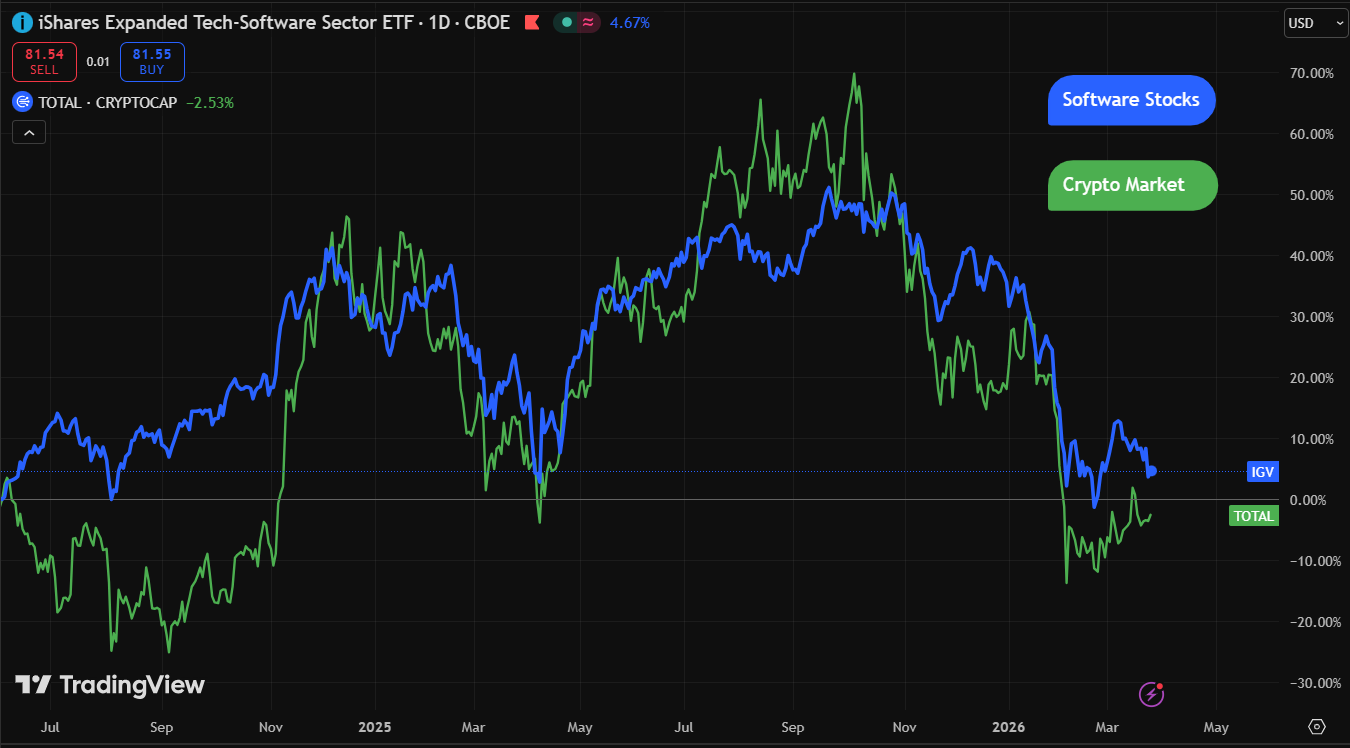
But as we have outlined, crypto is something fundamentally different. It is infrastructure that aligns directly with the requirements of an emerging agent economy.
That distinction matters — because it suggests that crypto is not merely exposed to AI-driven disruption, but positioned to benefit from it.
And yet, this is not how the market broadly sees it today.
The asset class remains widely misunderstood, relatively small, and not yet priced through this lens.
If that changes — if markets begin to recognize crypto as both the infrastructure of an emerging economic layer and a direct beneficiary of its growth — the implications could be significant.
In an environment where uncertainty increases and capital begins to reposition, crypto occupies a unique position.
It is not only an investment in a new technology aligned with an AI-driven shift. It is also a potential hedge against the disruption that AI introduces elsewhere in the portfolio.
Even a modest reallocation of capital could have outsized effects.
How quickly this reframing will occur remains uncertain.
But if the underlying thesis holds, the asymmetry becomes difficult to ignore.
Disclaimer:
The projects mentioned throughout this article (e.g., World, Bittensor, Akash, NEAR, Render) are provided for illustrative purposes only and do not constitute investment advice.
 | A guest post by
|
Nice work!